
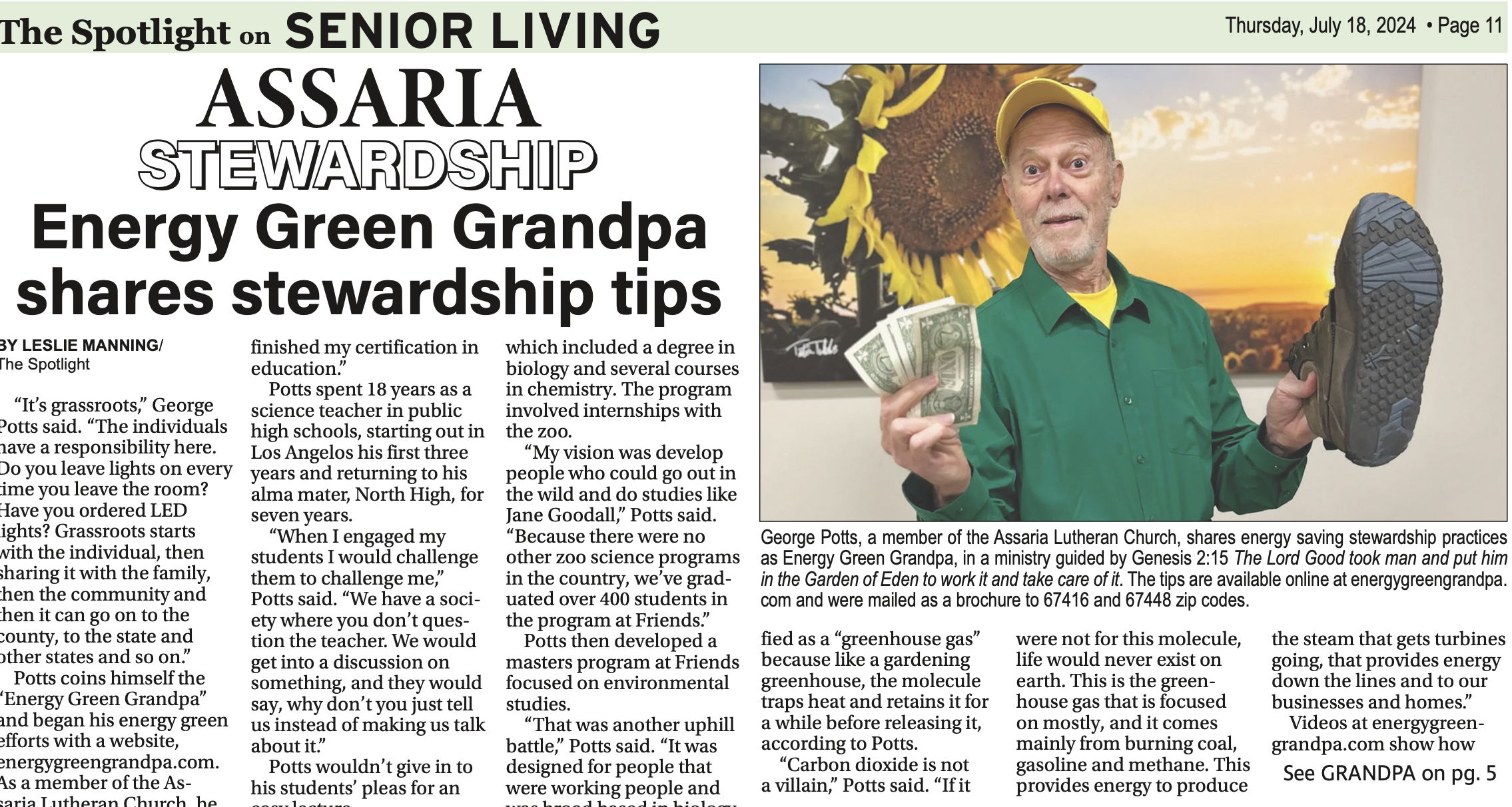
By Leslie Manning, The Spotlight
“It’s grassroots, George Potts said. “The individuals have a responsibility here. Do you leave lights on every time you leave the room? Have you ordered LED lights? Grassroots starts with the individual, then sharing it with the family, then the community and then it can go on to the county, to the state and other states and so on.”
Potts coins himself the “Energy Green Grandpa” and began his energy green efforts with a website, energygreengrandpa.com. As a member of the Assaria Lutheran Church, he launched the application of the energy green tips he offers online in the church building two years ago.
The stewardship ministry, based on Genesis 2:15 The Lord God took man and put him in the Garden of Eden to work it and take care of it, expanded with an informational booklet mailed to households in the Assaria and Gypsum zip codes the first week of July to give individuals and households 23 stewardship
“It said in the introduction that greenhouse gases cause global warming” Potts said. “I knew that my honesty was going to provoke some people, but you’ve got to be honest and let people know where you are coming from. Some people didn’t like that introduction because it sounds top down, because of decisions that have been made based upon very solid science.”
Developing solid science education
“As a scientist, I believe that Christianity and science are compatible,” Potts said. “It’s extremely complex, but it is so much more glorious.”
Potts grew up in a Christian home, but as a teenager, he started doubting the details of the creation story. He recalls talking with his dad, and sharing his thoughts that Adam and Eve seemed more like a fairy tale.
“When I was introduced to biological creation according to Charles Darwin, my mind popped,” Potts said. “This was how the earth was created, and to me that glorified God so much more than some Biblical tale. From that moment on, the evolution of creation through natural selection never challenged my faith.”
Potts graduated from Wichita North High School, and attended Friends University, majoring in biology.
“My intent by my sophomore year was to be a biology teacher,” Potts said. “I had a couple teachers who said I should think about med school.”
Potts was accepted into medical school, and completed studies for two years.
“It was not really my call-ing,” Potts said. “I dropped out of medical school, and went to Wichita State and finished my certification in education.”
Potts spent 18 years as a science teacher in public high schools, starting out in Los Angelos his first three years and returning to his alma mater, North High, for seven years.
“When I engaged my students I would challenge them to challenge me,” Potts said. “We have a society where you don’t question the teacher. We would get into a discussion on something, and they would say, why don’t you just tell us instead of making us talk about it.”
Potts wouldn’t give in to his students’ pleas for an easy lecture.
“I would say, ‘You’ve got to be able to think and you’ve got to be able to ana-lyze,” Potts said. “I’d say, ‘You’re not going to have me following you around giving you answers. You’re going to have to find them yourself.”
In 1965, Potts developed the Energy Education curriculum for the Wichita Public Schools, and sponsored an Ecology Club at Wichita North High.
“I sponsored it for about six years,” Potts said. “It really didn’t get rolling until the second year. I could go on and on about what they did. They themselves earned national awards for their projects.”
Potts earned the U.S. President’s Excellence Award for Outstanding Achievement in Environmental Protection Services in 1973 for his work with the students in the Ecology Club. The student projects included a five week long, free summer program, traveling and studying through the state and studying the ecosystems of Kansas.
“I found out I was a pretty good teacher,” Potts said. “I could take complex science and make it interesting. I had a broad based science background, with a part of that being two years of medical school. My focus, I had been concerned about the environment my whole life.”
While teaching at Wichita North, Potts earned a masters degree from Wichita State in science education and environmental sciences in 1970. After taking a sabbatical to work on a PhD, he returned to teach at Wichita South High School. He completed his PhD in 1976 in environmental education and environmental sciences.
Potts went on to teach science at Friends University in Wichita until 1991.
“I would have my students all the time doing projects at the Sedgwick County Zoo,” Potts said. “I got to thinking, are there any colleges that have a zoo science program? I asked the director of the zoo, and he said there were a couple colleges on the east coast that have associate degrees in zoo technology.”
Atter several years of conversations with the director, Potts went on to develop a four year zoo science program at Friends University, which included a degree in biology and several courses in chemistry. The program involved internships with the Zoo.
“My vision was develop people who could go out in the wild and do studies like Jane Goodall,” Potts said. “Because there were no other zoo science programs in the country, we’ve graduated over 400 students in the program at Friends”
Potts then developed a masters program at Friends focused on environmental studies. “That was another uphill battle, Potts said. “It was designed for people that were working people and was broad based in biology, chemistry, environmental law, measurements and techniques. We had engineers, we had teachers, and chemists and people from the Kansas Department of Wildlife and Parks.”
According to Potts, the Friends graduate program in environmental studies lasted 20 years and graduated 150 people.
According to the en-ergygreengrandpa.com website, after his university tenure, Potts founded George Potts & Associates Environmental Education Consultants. He was named the 1993 Conservationist of the Year by the Kansas Wildlife Federation. For 24 years he coordinated the Outdoor Wildlife Learning Sites (OWLS) program through the Kansas Department of Wildlife and Parks, which provided immersive science-learning environments on Kansas public school campuses.
Potts authored several books and articles over the course of his career, including A Checklist of the Vertebrate Animals of Kansas
(1991), Watching Kansas Wildlife (1993), the Kansas chapter of The Smithsonian Guides to Natural America: The Heartlands (1997), and the Pocket Guide to Common Kansas Mammals (2005).
Sharing science and faith
“I provoke people to force them to think, and I provoke people all the time” Potts said. “The introduction of the Energy Green Household booklet really angered some people, but that’s the way you get attention in many ways. I struggled with the introduction, but I decided to go with it, because it’s the truth.”
At energygreengrand-pa.com, several links are provided to resources explaining the science behind Potts provocation, as well as videos he has orchestrated himself. The provocative language used both at energygreengrandpa.com and in the Energy Green Household booklet is rooted in Potts experience studying and teaching science.
“Some of the research started on carbon dioxide as early as 1820, Potts said.
“A physicist in France basically said, carbon dioxide holds heat.”
Carbon dioxide is classified as a “greenhouse gas” because like a gardening greenhouse, the molecule traps heat and retains it for a while before releasing it, according to Potts.
“Carbon dioxide is not a villain,” Potts said. “If it were not for this molecule, life would never exist on earth. This is the greenhouse gas that is focused on mostly, and it comes mainly from burning coal, gasoline and methane. This provides energy to produce the steam that gets turbines going, that provides energy down the lines and to our businesses and homes.”
Videos at energygreen-grandpa.com show how light rays turn into heat waves, and are trapped in carbon dioxide molecules. Photosynthesis uses a lot of carbon dioxide, but the excess carbon dioxide produced over the last two centuries creates a challenge of balance.
“It’s a no brainer on the scientific cause of why it is heating up,” Potts said.
“The industrial revolution has pumped carbon dioxide into the air, and the carbon dioxide molecule stays around for hundreds of years. It stays there in the bottom six miles of the stratosphere.”
Potts recalls research from Charles David Keeling in 1958. Keeling developed a carbon dioxide concentration apparatus, and set it on a mountain in Hawaii.
He logged data for years, while at the same time, other scientists were measuring the same thing in other parts of the world. What they found was that the measurements showed the world heating up with the increase of carbon dioxide.
“As long as you have new carbon dioxide coming from fossil fuels, it just builds up,” Potts said. “It has increased more than 1.5 degrees Celsius, almost two.”
According to Potts, the research from the 1800s created a baseline for measurement around 1850, and the temperature has increased since that time. Which means, the language of environmental science has been used to track data and develop public awareness for centuries.
“I remember in my textbooks when I was teaching graduate school and the term carbon footprint first came out,” Potts said. “I had started my masters program. That terminology has been around a long time.”
According to Potts, the term carbon footprint goes back 30-40 years, when scientists started getting serious about greenhouse gases.
“When you leave a room, and you leave a light on, the source of electricity for light might be from a coal burning electric plant,” Potts said. “If you’d have turned that light off, it would save some carbon dioxide from the atmosphere. That actually reduces your carbon footprint.”
Potts remembers the first terminology used to describe the trapped greenhouse gases in the stratosphere – global warming.
“Which was commonly used,” Potts said. “Now it is climate change. Why they do that is the cause and effect. The cause of warming the atmosphere has different effects in different parts of the world. It can cause desserts to increase, more floods or greater snow falls.”
Coordinating a Christian ministry around a scientific understanding of the environment shares the faith and the expertise that Potts has developed over the course of his lifetime.
“I know there is a designer, who drafted this process.” Potts said. “As a Christian, I regard this knowledge as real and true. Because we have a creation beyond ourselves, it is my opinion that God wants us to conserve and protect his total creation.”
Potts, as the Energy Green Grandpa, would like to see a grassroots effort begin in this place where his children live, and his grandchildren (Luke and Cedar VanTassel) graduated from high school – to maintain the legacy of inheriting a balanced and healthy creation, as well as inheriting a relationship with the creator.
“This whole idea of saving energy in the household and in the community, and having people get an awareness of the environment is what we can do to make things a little bit better, Potts said. “I can see the connection when we are wasting energy, and it’s not doing any good. It’s negligent.”